QA and the invisible pillar of software development
- January 2025 |
- 03 Mins read
The term Quality Assurance is still too often invoked as a synonym for testing, or treated as a residual phase to be slotted in between the end of development and a production release. This conceptual reduction has concrete consequences on products and teams: when quality is perceived as a checkpoint rather than a permanent dimension of the process, problems tend to accumulate silently until they become difficult to address without a disproportionate cost. Understanding QA in its true scope means recognizing it as a cross-cutting approach that spans every phase of the software lifecycle, from requirements definition to user feedback collection in production.
The distinction between QA and testing
Testing is a fundamental tool within QA, but equating the two terms produces a limited and ultimately counterproductive vision. Through manual or automated tests, it is possible to verify that code behaves according to specifications and that the end user experience is consistent with what was intended. This kind of verification happens predominantly after the fact, after architectural decisions have already been made. QA intervenes much earlier: it concerns the definition of acceptance criteria before the code is written and the assessment of risks associated with each component of the system. Using the analogy of building a bridge, testing is equivalent to verifying that the beams handle the expected load; QA is the structural engineering work that determined which beams to use and with what safety margin. The difference is not simply a matter of timing, but of depth of intervention within the system.
The shift-left paradigm
One of the most significant evolutions in QA practice in recent years is the progressive anticipation of verification activities toward the early phases of the process, a tendency commonly referred to as shift-left. The underlying idea is that the cost of correcting a problem grows in a non-linear way as the system advances through its development cycle: an ambiguous requirement discovered during requirements gathering calls for a conversation; the same requirement discovered in production requires an incident management meeting, an emergency patch, and a root cause analysis. Practices such as behavior-driven development, where acceptance criteria are written before development begins, and architectural review sessions anticipate risks before decisions become difficult to reverse, reducing the volume of problems that reach the later and more expensive stages of the process.
Who holds responsibility for quality
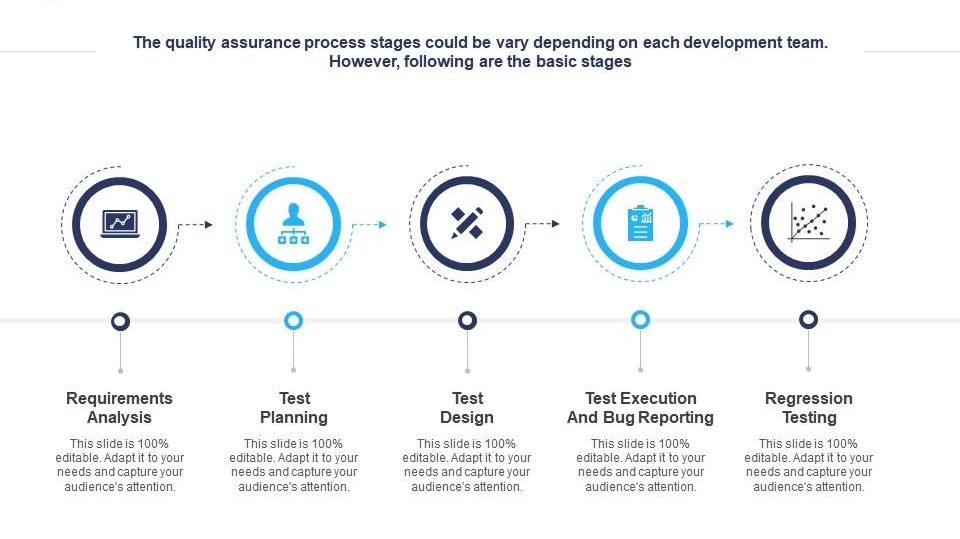
The most honest answer is that it depends on context and evolves over time. In a startup, responsibility falls on the developers themselves: careful exploratory testing, a deep understanding of the critical user flows, and code review as a first qualitative filter. When the product grows, automation becomes indispensable: end-to-end tests, regression tests, and continuous integration pipelines that execute the test suite on every code change. In more mature organizations, QA structures itself as a dedicated function with specialized roles collaborating with developers, designers, and product managers, participating in requirements definition and release planning. In this scenario, QA stops being an external control and becomes an internal service that accelerates the development cycle rather than slowing it down.
The cost of quality and its real return
The economic argument against QA is familiar: it costs time, requires specific expertise, and reduces the perceived velocity of development. This assessment is often correct in the short term and completely wrong over the long run. The relevant comparison is not between the cost of QA and zero, but between the cost of QA and the cost of its absence. A critical bug discovered in production generates direct correction costs, reputational costs that affect the perception of the product, and in the most serious cases, legal or regulatory compliance costs. The key to making QA sustainable lies in finding the right balance between coverage and velocity: automating repetitive verifications, concentrating human attention on the most critical paths, and accepting that intelligent coverage at ninety percent is more useful than nominal coverage at one hundred that produces false signals and slows the release cycle.
Quality as a cultural dimension
The deepest transformation that QA can produce in an organization is not technical but cultural. When quality is perceived as the responsibility of a single team, every other member stops feeling part of the quality process. When it becomes instead a shared dimension, product managers write more precise requirements because they understand that ambiguity generates problems that are difficult to discover later, designers test their hypotheses with real users before code is written, and developers consider testability a quality attribute on par with readability and performance. The return on this investment is measured in the reduction of accumulated technical debt, in the sustainable velocity of the development cycle over the medium term, and in the trust that users develop toward a product that behaves in a predictable and reliable way. In a market where perceived quality is increasingly a differentiating factor, building this culture is a strategic choice with a direct impact on the competitiveness of the product.