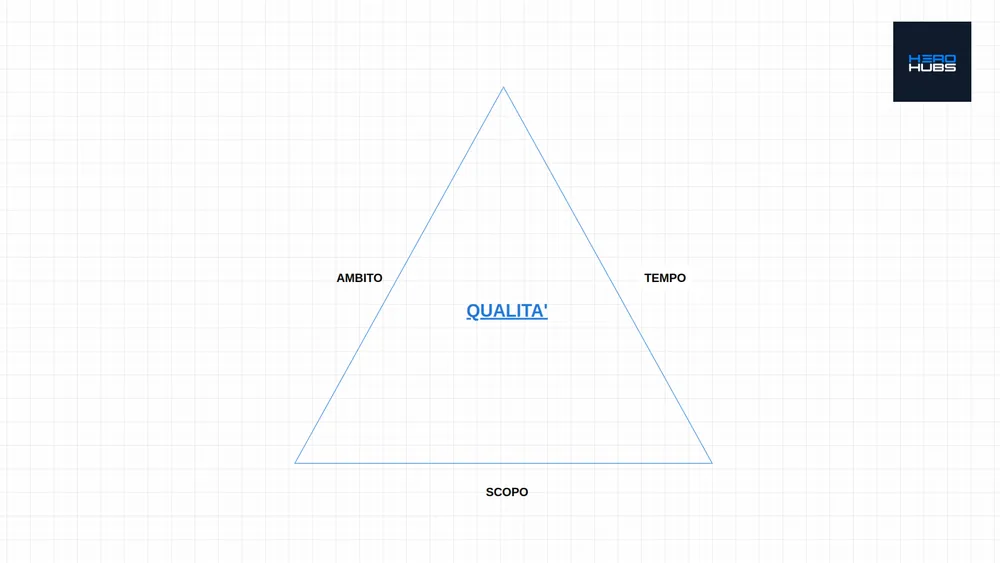
The project management triangle
-
- Projects |
- April 2025 |
- 03 Mins read
If you have worked on a complex project, you have probably found yourself in the situation where new features were requested almost daily, with tight deadlines and the expectation of impeccable quality.
A common but unsustainable situation to manage, and often complicated to explain.
A help in this regard comes from the project management triangle, also known as the delivery triangle or iron triangle.
This concept represents three fundamental constraints that every project must face:
The scope: the amount and complexity of the work to be done; The time: the deadline by which the project must be completed; The quality: the level of excellence required for the final result; The triangle’s key rule is that you can optimize at most two of these three constraints, but not all simultaneously. This means that one will necessarily have to be sacrificed to ensure the project’s success.
Compromises
The project management triangle forces us to take difficult but necessary decisions. Here is how the constraints influence each other:
Scope and quality: if you want to expand the project’s scope and maintain high quality, you will have to sacrifice time; Scope and time: if you want to deliver quickly a project with many features, quality might suffer; Time and quality: to ensure tight times and high standards, you will have to reduce scope and focus on an MVP (Minimum Viable Product); This awareness is fundamental to establishing realistic priorities. For example:
If time-to-market is essential, you might reduce some features or accept compromises on quality. For critical systems, like medical or safety software, quality will be prioritized, at the expense of speed or scope. With limited budgets, you might have to downsize the project or extend its times to maintain quality.
The cost
The traditional triangle does not consider cost directly, but it is an essential and closely linked element:
Accelerating times often requires additional resources, increasing costs. Also expanding scope implies more work and therefore higher costs, and improving quality can require highly qualified personnel or advanced tools, increasing the budget.
Managing these interactions is crucial to keep the project on realistic tracks.
However, indiscriminately increasing resources (e.g., adding personnel) does not always bring proportional results, on the contrary.
Strategies to manage the triangle
Even if the triangle’s constraints are inevitable, there are strategies that can mitigate their impact:
Iterative delivery: subdividing the project into phases allows releasing main features quickly, postponing less urgent ones; Modular architecture: a modular system (like modular monolith) allows developing individual components without compromising overall quality; Test automation: automated tests maintain high quality even increasing development speed; Technical debt management: it is fundamental to recognize when you are sacrificing quality for speed or scope and plan future interventions to avoid technical debt becoming unsustainable; Clear communication: ensure that all stakeholders understand the necessary compromises. This helps create realistic expectations and prevent conflicts; Deadlines and timeboxing: Parkinson’s Law states that work expands to fill all available time. Imposing deadlines and subdividing time into blocks helps maintain control; Agile and Scrum: Agile methodologies address the triangle’s constraints through iterative development, continuous priority review, and active stakeholder involvement; Quality as strategic investment: an often overlooked element is that investing in quality from the early stages of a project can seem slower, but significantly reduces technical debt, allowing acceleration in subsequent phases. Quality, therefore, should never be sacrificed lightly; The project management triangle is not just an abstract theory, but a practical tool to understand and manage project dynamics. Accepting that not everything can be obtained — and communicating clearly the compromises to involved parties — is the key to success.
Balancing scope, time, quality, and cost requires skills and strategies, but with a conscious approach it is possible to achieve realistic and sustainable objectives.