Exponential organizations
-
- Projects |
- January 2025 |
- 05 Mins read
Until a few years ago, building a company capable of reaching a billion-dollar valuation required decades of work, substantial capital, and a consolidated physical infrastructure. Then came cases that seemed impossible: Instagram was acquired by Facebook for one billion dollars in 2012 with just thirteen employees, WhatsApp for nineteen billion in 2014 with a little over fifty, and Airbnb passed a billion-dollar valuation in about three years without owning a single property. The key to this apparent contradiction lies in the model of exponential organizations, abbreviated as ExO, a paradigm that redefined the way of building and scaling a company in the digital age and that today, with the arrival of AI agents, becomes relevant again in a form its authors could not have foreseen.
What an ExO is
The model was formalized in 2014 by Salim Ismail, together with Michael Malone and Yuri van Geest, in the book “Exponential Organizations”. The definition is deliberately measurable: an exponential organization is a company whose impact, or output, is disproportionately large compared to its peers, at least ten times greater, thanks to organizational techniques that leverage accelerating technologies. Unlike a classic company, which grows linearly by proportionally increasing its structure, workforce, and operating expenses, an ExO grows by orchestrating external resources it does not directly own, and for this reason the cost of each new customer or each new market tends to fall instead of remaining constant.
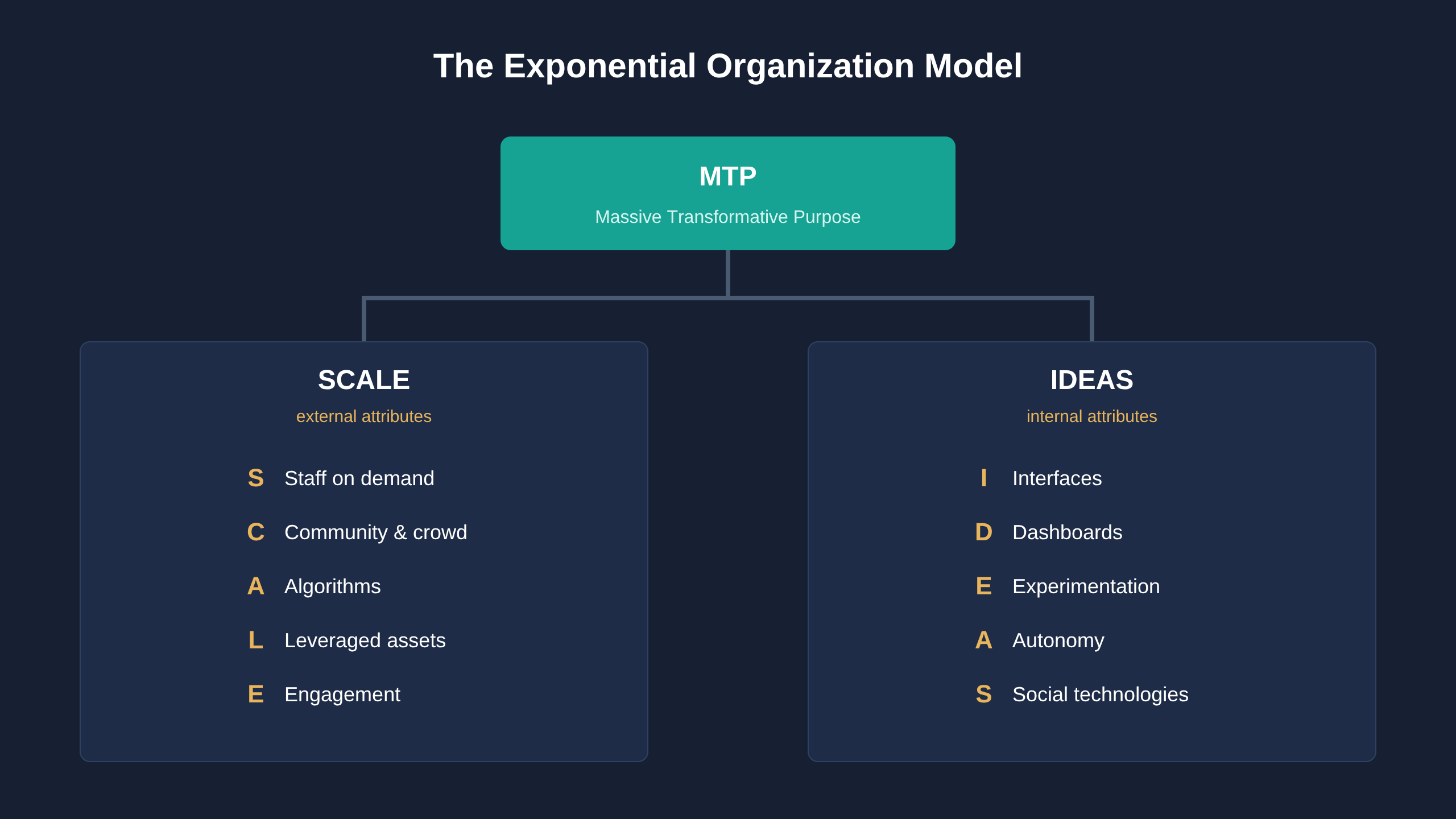
At the center of everything the book places the Massive Transformative Purpose, a purpose so broad and ambitious that it attracts people, communities, and partners well beyond the boundaries of the company. “Organize the world’s information” for Google or “Ideas worth spreading” for TED are not marketing slogans but compasses that make it possible to coordinate external contributions without having to control them one by one.
SCALE and IDEAS: the attributes of the model
Around the purpose, Ismail describes ten attributes grouped into two acronyms. SCALE concerns the relationship with the outside world and includes staff on demand, meaning skills activated when needed instead of permanently hired, community and crowd as a source of ideas, work, and validation, algorithms that automate operational decisions, leveraged assets used instead of owned ones, and engagement, the mechanics that keep users and participants involved. IDEAS concerns the internal organization instead and includes interfaces that filter and route the value produced outside, dashboards with real-time metrics, continuous experimentation in place of rigid planning, the autonomy of small multidisciplinary teams, and social tools that shorten decision times. No company adopts all of them, but according to the book those that grow exponentially usually combine at least four.
How it works in practice
Airbnb remains the most cited example because it consistently embodies leveraged assets and community. The company owns no property, yet it has become one of the leading players in global hospitality by connecting hosts and guests through a platform that sustains itself through reviews and mutual trust. Its main asset is not physical but relational, and this is precisely what makes it so hard to replicate with the means of the traditional hotel industry.
Waze instead shows the power of community in an almost pure form. The traffic map was not built by a fleet of company vehicles but by the users’ own smartphones, which reported slowdowns, accidents, and detours while driving, and when Google acquired it in 2013 for about one billion dollars the company had around a hundred employees. AWS, finally, is not an exponential organization in the strict sense but has been its great enabler, because making the same infrastructure as a multinational available to any startup, charged on a consumption basis and without upfront investment, made the leveraged assets attribute concrete for anyone wanting to build a digital product.
Staff on demand is changing its nature
In 2014 staff on demand meant freelance platforms and open competitions like those on Kaggle, where a public contest replaced a data science department. Today that attribute is changing its nature, because a growing share of the skills that can be activated on demand is no longer made of people but of AI agents. Tools are emerging that let you assign distinct roles to several agents, each with its own tasks and limits, and even a small business can hand a team of agents its marketing, its social media content, or the first replies to customers. It is staff on demand in its most extreme form, and it brings other attributes of the model along with it, because agents are algorithms that make operational decisions and the log of their activity is in effect a real-time dashboard.
The most relevant change is not technical but one of scale. For years the ExO model seemed a paradigm reserved for venture-backed startups, whereas today its attributes are within reach of a small business with no IT department and no corporate budget, as long as it knows how to orchestrate what it does not own.
The limits of the model
It would be a mistake, however, to read exponential organizations as a foolproof recipe. The book mostly describes those who made it, and several companies cited as examples no longer exist: Quirky, the platform that turned its community’s ideas into products, went bankrupt in 2015, and Groupon, long a symbol of the fastest growth in history, lost most of its value a few years after going public. Growing without owning also means depending on those who own, whether it is the platforms that carry distribution, the communities that can move elsewhere, or, today, the providers of the models the agents run on. Anyone adopting the model must therefore know which dependencies they are accepting and what would happen if one of them changed its price or terms overnight.
Thinking big as a structural necessity
Larry Page made 10x thinking one of Google’s principles, with a line of reasoning that captures the ExO mindset well. A project aimed at improving a process by ten percent competes in a crowded space where many others are working toward the same goal, whereas a project aimed at a tenfold improvement forces a rethink of the problem from the ground up and operates in a space where competition is far more sparse.
Adopting the mindset of exponential organizations does not necessarily mean becoming the next Airbnb, but reasoning with the same clarity about which resources can be orchestrated instead of owned, which communities can be engaged instead of merely served, and which data can be used to decide better and faster than competitors. With AI agents this question stops being theoretical even for someone running a small shop around the corner, and the difference will be made by those who can design the purpose, the roles, and the checkpoints before even choosing the tools.