Scion: why did Anthropic leave git for its monorepo?
- |
- October 2026 |
- 6 min read
For anyone who has been writing software for a few years, git has become something like air, a tool so pervasive that it is no longer perceived as a choice. That is exactly why it is striking to read that Anthropic has replaced it in its monorepo with Scion, a version control system built in house by a team of seven people in about five months. It sounds like the story of a company reinventing the wheel, but Anthropic’s account shifts the focus from git as a tool to the kind of load git was designed for. The bottleneck, the company explains, is no longer writing code but the infrastructure around it, from source control to the continuous integration pipeline, both sized for developers who make a few commits a day and not for swarms of agents that produce thousands. It should not be confused with Google’s Scion, a testbed for orchestrating agents in containers that uses git and has nothing to do with this project.
The numbers that broke git
The figures explain better than any theoretical argument why the classic solutions stopped being enough. In May 2026 the monorepo received about 2,500 merged changes a day, by September there were more than 30,000, with a main branch history approaching 100 GB and a compressed working copy above 25 GB. Continuous integration alone performs about 25 million checkouts a day, not counting agent sandboxes and development environments. If each of these clients downloaded the repository naively, traffic would exceed 600 PB a day. For years Anthropic held on with the classic arsenal: shallow clones, which download only the latest commits instead of the whole history, sparse checkout, which puts on disk only the directories needed, promisor remotes, which fetch commits and folders and let file contents arrive only when needed, and several hundred internal mirrors, copies of the repository close to the CI machines. Every increase in the merge rate, however, made those mirrors more fragile, because each one had to chase a main branch in constant motion, and trivial operations such as diff and blame on partial clones became an exercise in patience, since every missing file had to be requested from the server.
An opposite starting assumption
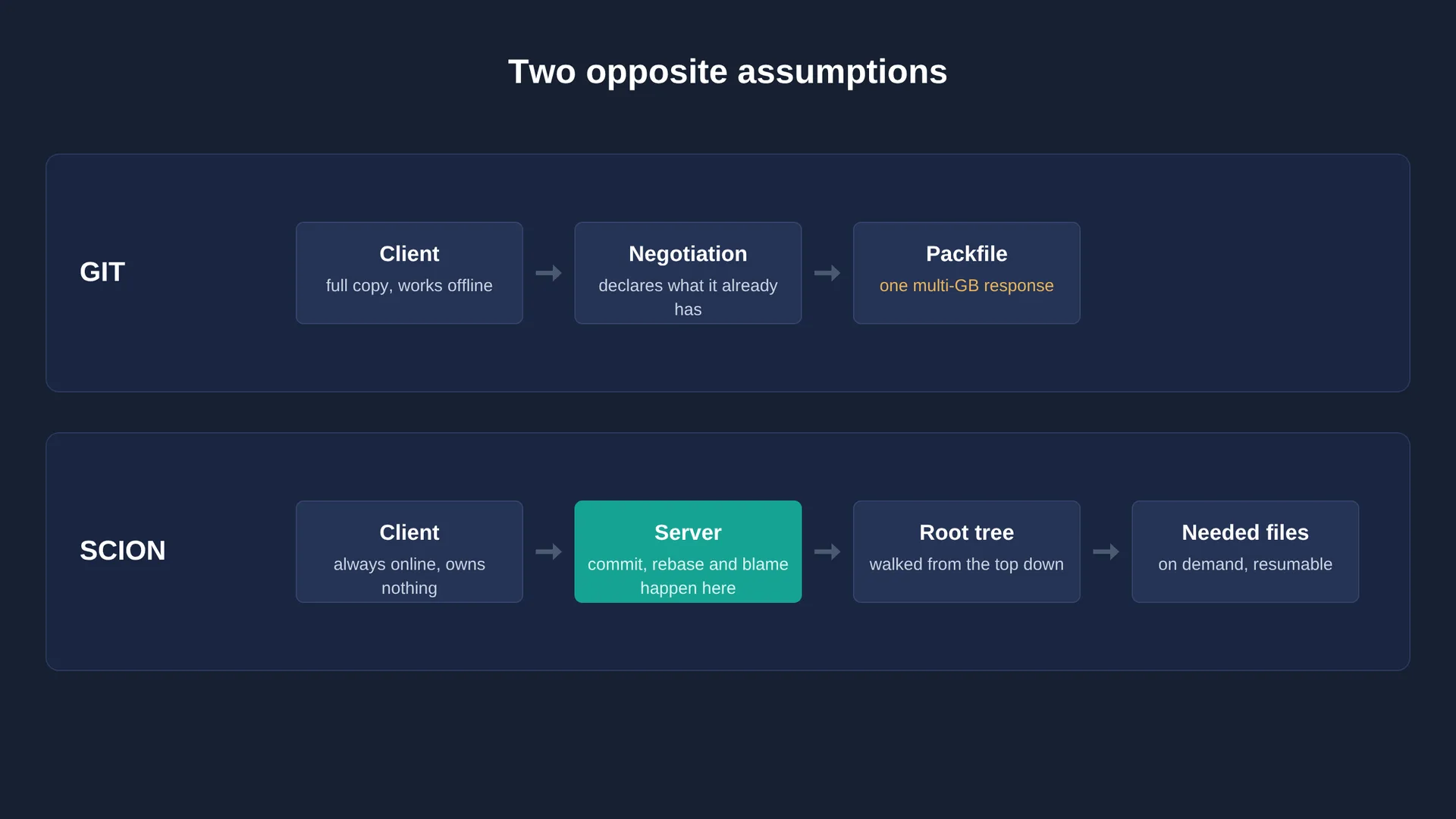
The difference between git and Scion does not lie in a single algorithm but in the assumption each one starts from. Git assumes that every machine holds a complete copy of the history and that work can happen offline, computing commits, rebases, blame and merges locally and then synchronizing with a push. Scion turns the model upside down. At the center sits a server that holds the only official version of the repository, while clients stay connected at all times, keep no copy of it and ask for data only when they need it. The operations git runs on the developer’s machine happen on the server: a commit or a rebase is recorded there directly, so there is nothing to send with a push, and a file’s history or its blame, that is who wrote each line, are requested from the server through an API. Branches and tags are discouraged, except for main and release branches, because every ref is a piece of state that all servers have to share. The working copy becomes optional too: a CI job can ask the server only for the differences a change introduces without downloading a single file, and when files are really needed they are materialized on disk only at the moment someone uses them. The most instructive comparison concerns data transfer. In git the client lists what it already has and the server answers with a packfile, a single archive with everything that is missing, which at this scale can weigh several GB. In Scion the client starts from the top folder and walks down level by level, asking only for the folders and files it needs, in a transfer that can resume where it left off if the connection drops.
How it works under the hood
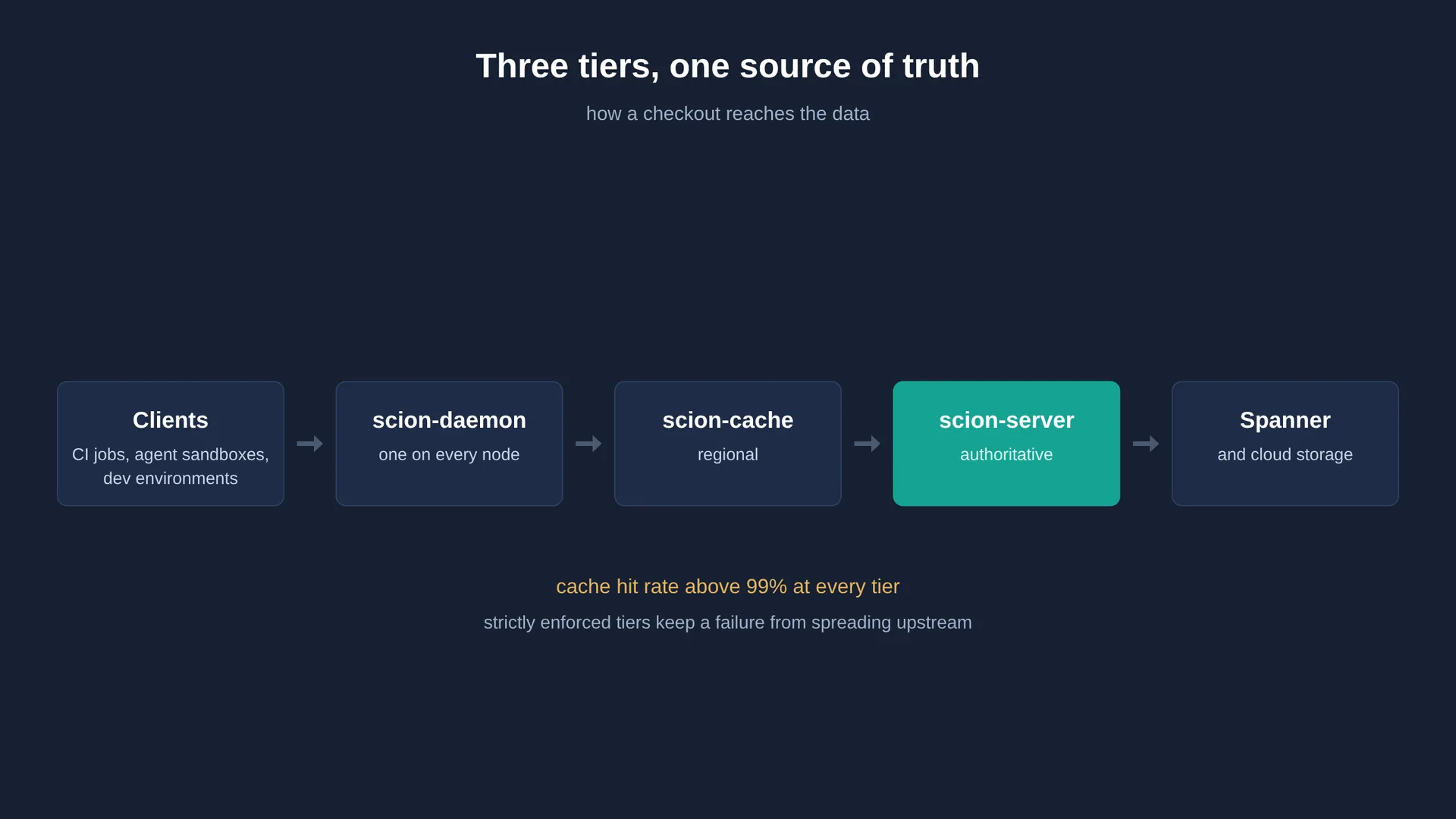
The unit of work in Scion is the changeset, a row in a write-ahead log that, unlike a git commit pointing to an entire tree, lists only the files changed relative to the first parent and refers to their compressed content in blob storage through an address computed from the content itself. History and blame are derived data, computed by walking up the parents, and the client never sees the details, so Anthropic can change them without touching developer tooling. The only thing that changes over time is the refs, such as the one pointing to the latest version of main, and every update is an atomic operation on a single row of Spanner, Google’s distributed database: if two changes arrive at once, only one goes through. Everything else never changes once written, which is why any server can keep a cached copy without having to agree with the others. Client requests go through three tiers, as the diagram below shows: a process on every machine, a cache in every region and finally the official servers, which read the data from Spanner and cloud storage. The hierarchy is deliberately rigid, so a failure in one tier stays isolated instead of spreading. With no packfiles to optimize, repository maintenance disappears too. The reported results are striking: more than 99% of requests are answered from cache, the infrastructure uses 200 times fewer resources than the old mirrors, a checkout takes seconds instead of minutes and CI has recovered a quarter of its computing capacity. These are internal figures, though, which cannot be verified from the outside.
Claude’s role in building it
The handwritten prototype of the pipeline that imports history from git was rewritten by Claude Mythos Preview, using twenty times less memory and running four times faster, while preserving the implicit invariants of the original code. The engineers’ work shifted accordingly towards defining architecture, trade-offs and constraints, frequently rejecting proposals that violate system constraints or are simply overengineered, with reviews that look at the intent of a change more than at individual lines. Alongside Scion came Antique, a code review tool whose approvals can distinguish a change that only touches comments from one that alters logic. On merging, Anthropic gave up on a global lock, impossible to sustain at this scale, and relies on tests run after merge and before deploy, letting Claude resolve most conflicts before a human even notices them.
Why it is not a git replacement
The most useful part for anyone working with git every day is the caution of Anthropic itself, which describes Scion as unsuitable for general use and sensible only for gigantic monorepos, with tens of thousands of engineers or swarms of agents, and which has published neither its code nor a repository. The path is not new either, since Google has long followed a centralized model with Piper and Meta open sourced the Sapling client in 2022. What is new is what drives the change, namely the volume of code produced by agents, along with the prediction that problems of this kind will become common within six to twelve months. This is why the company proposes bringing some of Scion’s ideas into git, with servers offering complete APIs and different negotiation protocols, working together with GitHub, GitLab and the open source community. For a team with a repository of a few GB and a dozen developers nothing changes today and git remains the right tool, but the signal about direction is hard to ignore: if agents write a growing share of the code, the limits show up in the infrastructure before they show up in the models, and anyone designing systems would do well to ask which of their tools is still sized for human rhythms.
To learn more: https://www.anthropic.com/engineering/redesigning-source-control