Dependabot: updating dependencies is a policy, not a bot
- |
- November 2026 |
- 5 min read
Almost every repository on GitHub has met Dependabot in the same way, with a morning when the pull request list fills up with update proposals signed by a bot, one for every library that has fallen a few versions behind. The most common reactions go in two opposite directions, as some people approve them in bulk without reading them and others stop looking at them until the counter becomes embarrassing, and in both cases the tool ends up being judged as a source of noise. It is an understandable reading but a wrong one, because Dependabot decides nothing on its own: it executes an update policy with great punctuality, and when that policy is not written down explicitly the bot applies the default one, which consists of proposing everything, immediately and separately.
An open source engine with two different features
Dependabot started as an independent service built in London by Grey Baker and Harry Marr and was acquired by GitHub in 2019, which in the following years integrated it into the platform and made it free for every repository. Today it lives in the dependabot organisation, where the heart of the system is dependabot-core, an MIT licensed Ruby library containing the logic that reads the manifests of the different ecosystems, resolves compatible versions and generates the file changes. Alongside it there is a CLI written in Go that runs the same update jobs locally, an action called fetch-metadata that exposes to workflows the details of the dependency touched by each pull request, and a demo repository to start experimenting with. The fact that the engine is open source has a practical consequence few people consider, because when an update behaves unexpectedly the answer is almost always found in the issues and the code of dependabot-core, not in documentation that only describes the intended behaviour.
Under that same name, however, two mechanisms live side by side, and it pays to keep them apart. Security updates start from the GitHub Advisory Database: when a known vulnerability affects a version present in the dependency graph the repository receives an alert and, if the feature is enabled, a pull request that moves the library to the first patched version. Version updates, on the other hand, have nothing to do with vulnerabilities and exist to keep the project close to the latest releases, following the schedule and the rules described in the .github/dependabot.yml file. The distinction matters because the two flows answer different questions, the first one how quickly to close a known exposure and the second one how much technical debt you are willing to accumulate, and several configuration options apply to only one of the two.
The configuration file as a statement of intent
version: 2
updates:
  - package-ecosystem: 'npm'
    directory: '/'
    schedule:
      interval: 'weekly'
      day: 'monday'
    open-pull-requests-limit: 5
    groups:
      # Minor and patch bumps travel together in a single pull request
      minor-and-patch:
        update-types: ['minor', 'patch']
    cooldown:
      default-days: 5
      semver-major-days: 30
  - package-ecosystem: 'github-actions'
    directory: '/'
    schedule:
      interval: 'monthly'
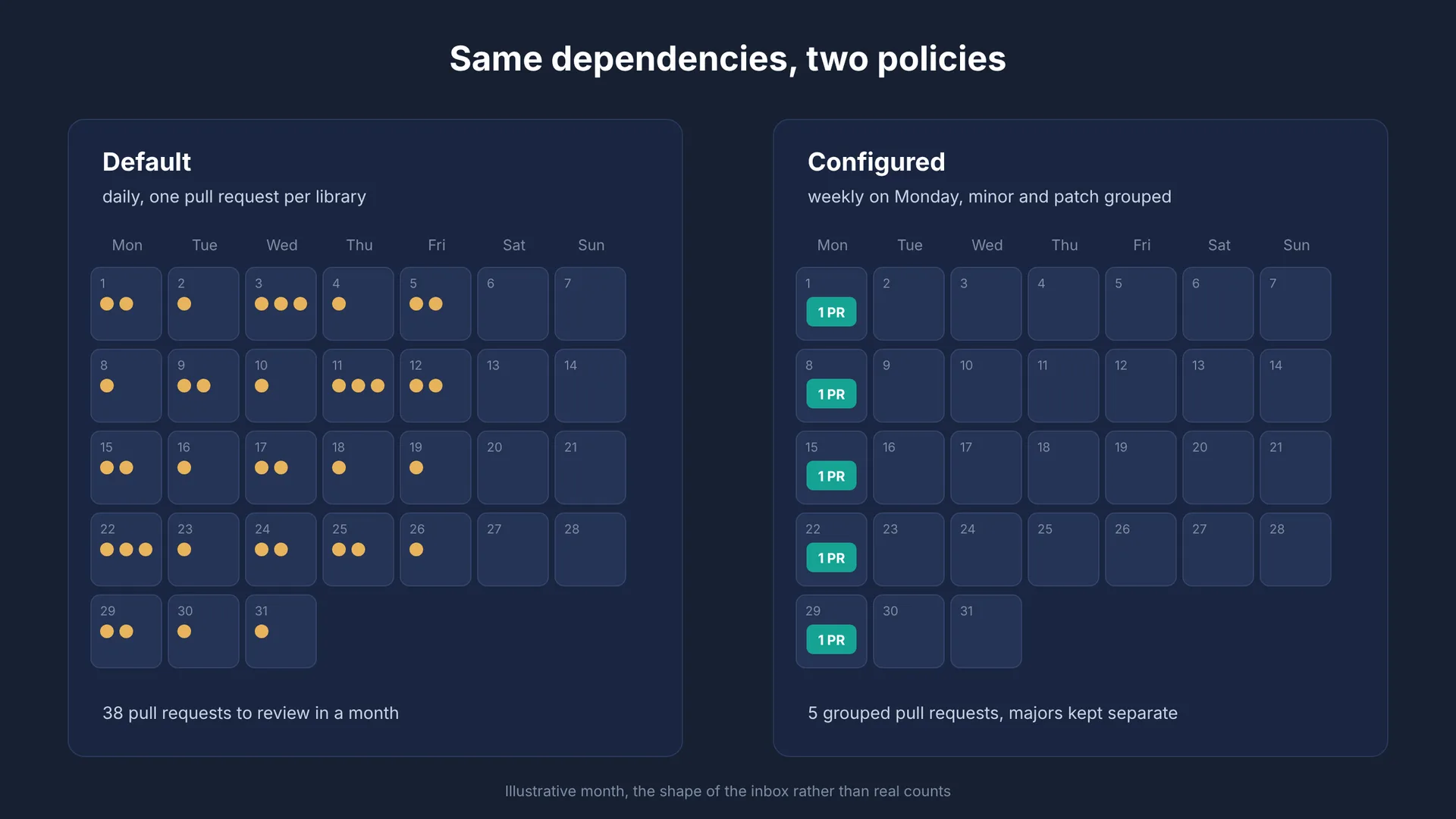
The options that really make a difference are few. The schedule sets the pace, weekly or monthly rather than daily, with the ability to pick the day and time so that pull requests arrive when someone actually has time to look at them. The limit on open pull requests, which defaults to five, prevents a neglected project from being flooded in a single night. Groups are the most effective lever against noise, because they collect minor and patch updates into a single pull request and keep separate only the major version jumps, the only ones that deserve a careful read of the changelog. Since July 2025 groups can also span ecosystems, so that the Docker image, the Terraform module and the Python libraries of the same service arrive together in a single review instead of three unrelated pull requests.
Cooldown as a supply chain defence
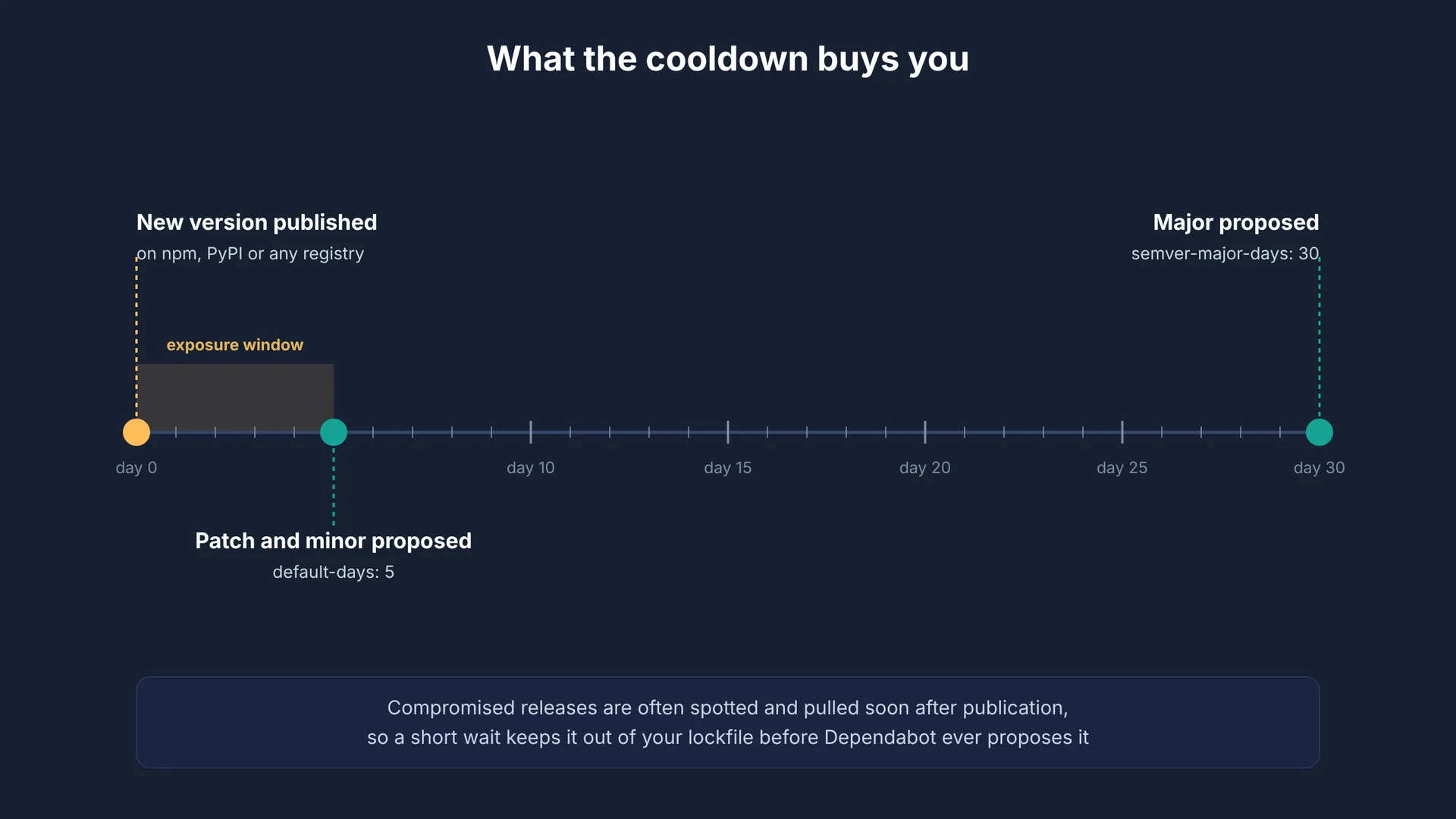
The most interesting addition of recent months is not about convenience but about security. The cooldown option enforces a waiting period between the publication of a new version and the moment Dependabot proposes it, with separate values for major, minor and patch jumps and the ability to include or exclude individual packages. Deliberately slowing down updates may look like a contradiction, but the recent attacks on the npm registry, such as the Shai-Hulud worm that in September 2025 compromised hundreds of packages by publishing malicious versions with credentials stolen from their maintainers, showed that the most dangerous moment in the life of a release is its first few hours. A compromised version is usually spotted and pulled quickly, and a project that waits a few days before adopting it never sees it arrive. Cooldown only applies to version updates, so a security fix still arrives immediately, and that is exactly the combination you need: speed when there is a known exposure, caution when there is only something new.
Automerge and trust in the pipeline
The last step is deciding what can get in without human intervention, and this is where fetch-metadata becomes useful. A workflow reacting to pull requests opened by Dependabot can read the update type and enable automatic merging for patches only, letting the continuous integration pipeline act as the gate. The condition for this to work is not about Dependabot but about the project, because an automerge is worth exactly as much as the test suite protecting it, and a repository with poor coverage that merges updates automatically is only moving the moment it discovers problems from review to production.
This is why the Dependabot configuration ends up being a good indirect test of a project’s health. If you do not trust a patch to go through with a green pipeline, the problem to solve is the pipeline and not the bot, and if update pull requests stay open for weeks the problem is a policy nobody ever wrote. Spending an hour on that file, deciding the pace, the groupings, the waiting periods and the trust thresholds, turns a source of noise into one of the few maintenance processes that genuinely run on their own.