Claude Science: when the assistant walks into the lab
-
- AI |
- August 2026 |
- 03 Mins read
On June 30, in front of an audience of pharmaceutical executives, biotech founders, and researchers, Anthropic unveiled Claude Science, a product built to support scientific research the same way Claude Code supports software development. The underlying idea is the one that already made Claude Code useful to engineering teams, an assistant able to carry out complex work on its own starting from concise, high level instructions, applied here to a domain where data does not live in a single repository but is scattered across dozens of databases, formats, and tools that rarely talk to each other.
Not a model, but a working environment
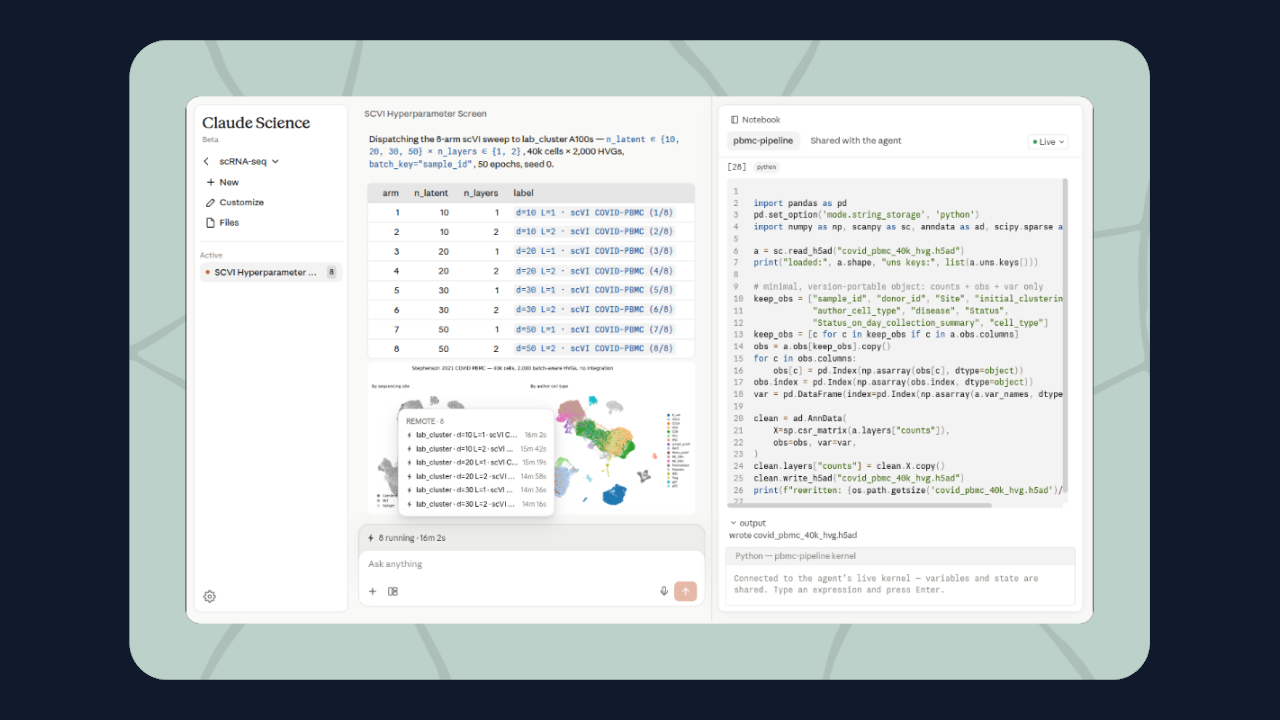
The point Anthropic wanted to make clear from the start is that Claude Science is not a new model and not a more capable version of Claude on biology. It runs on models already available, including Claude Opus 5, without special access or hidden capabilities. The bet is therefore not on the power of the underlying model but on the environment built around it, a workbench that consolidates databases, pipelines, and tools into a single working space. It mirrors the same logic behind Claude Code, where the value never came from getting a language model to write code, something models have been able to do for years, but from giving it access to the terminal, the filesystem, and the build tools so it could actually carry a task through to completion.
One coordinator and more than sixty specialists
Architecturally, Claude Science presents itself as a generalist agent acting as a project manager, able to take a request written in plain language, break it into parts and hand those parts to more than sixty tools specialised in the various branches of biological research, from genomics to proteomics to computational chemistry, with the option of drawing on external models dedicated to predicting molecular structures. The delicate part is not the number of tools but their heterogeneity, because the large public databases a researcher consults every day, from UniProt to Ensembl, were built at different moments and each has kept its own format and its own way of being queried. Holding those pieces together is the connective work that today eats a disproportionate share of a researcher’s time, and it is precisely where this tool tries to insert itself. The researcher asks the question in plain language and the system takes care of working out which sources to query, translating the request into the language of each one, putting the results back together and, when the problem calls for it, spinning up further specialist agents of its own.
Reproducibility as a requirement
A second distinctive feature concerns how Claude Science treats its own output. A dedicated reviewer agent checks citations and calculations, flagging or correcting errors before they reach the researcher. Every figure the system produces is saved together with the exact code that generated it, the execution environment, a plain language note on how it was built, and the full history of the conversation that led to that result. In a field where the reproducibility crisis has been a recognised problem for years, this kind of traceability is not a technical detail but a necessary condition for a tool like this to be accepted in a serious scientific setting, where a chart without its provenance carries no evidentiary weight at all.
From data to drugs for neglected diseases
Anthropic did not stop at releasing a tool, it also opened its own internal drug discovery program, focused on neglected diseases that traditional pharmaceutical companies consider commercially unattractive. The stated logic is a self reinforcing loop, hands on experience developing drugs feeds back into the product and a better product attracts customers in the biopharma industry. Novo Nordisk and the Allen Institute are among the early adopters. Among the examples cited, a UCSF researcher used Claude Science to spot a viral contamination in a dataset within minutes, a contamination that had gone unnoticed for a year using conventional methods, while in another case the tool analysed a hundred rare genetic diseases in under an hour, flagging thirty two candidates for further computational screening.
A three way race and a grant program
Claude Science lands on contested ground, with OpenAI and Google DeepMind working on equivalent tools, and Anthropic’s bet is that the edge will come from integration with the real workflows of labs rather than from raw model capability. To speed up adoption in academia the company will fund up to fifty projects with grants of up to thirty thousand dollars, aimed above all at PhD students and postdocs. It is the same strategy already seen with Claude Code in universities, and it aims to get a generation of researchers to treat an assistant like this not as an exception but as a colleague in the lab.
To learn more: https://claude.com/product/claude-science