Sakana Fugu: when value lies in orchestration, not in the model
-
- AI |
- July 2026 |
- 05 Mins read
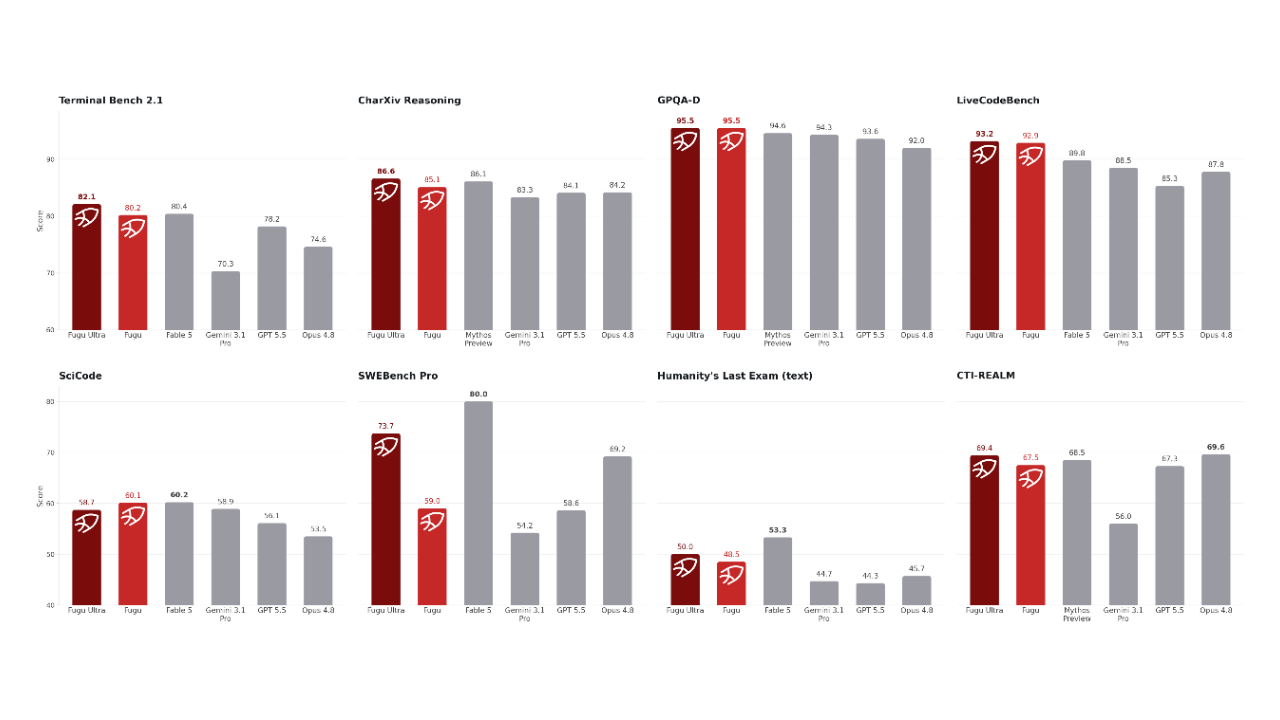
For years the race toward frontier models seemed an affair almost exclusively between the United States and China. Then Japan stepped up to the table with an unexpected move. Sakana AI announced Fugu and the first benchmarks immediately lit up the headlines, with performance that surpasses Opus 4.8 and comes close to that of the most recent models such as Fable 5. The immediate reaction of many commentators was to frame it as yet another model more powerful than its predecessors, and the by-now familiar pattern of the race toward computational power seemed to be repeating itself once more. The reality is more interesting and, in a sense, more subversive. Fugu, which in Japanese means pufferfish and continues the aquatic metaphor of Sakana, literally fish, is not a model in the traditional meaning of the term. It is a system that coordinates other models, and it is, on top of that, tiny.
What Fugu actually does
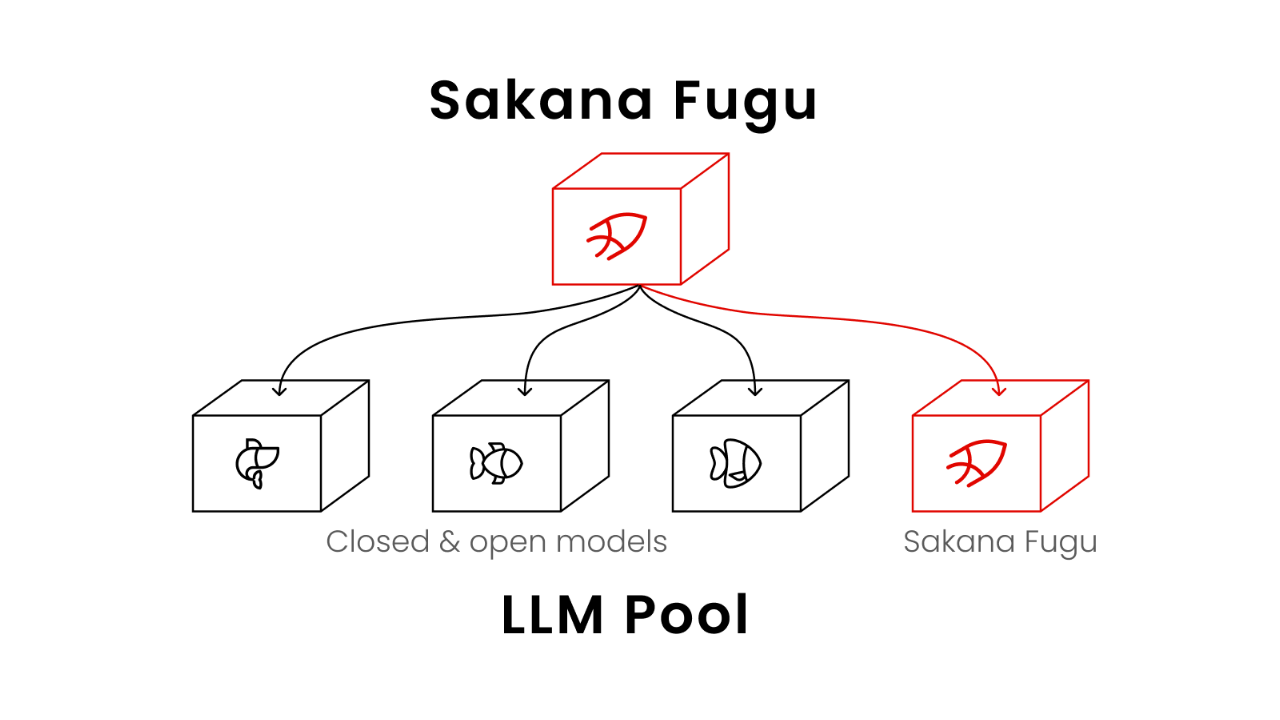
The distinction is not technical but conceptual, and it is worth dwelling on. A classical language model receives an input and produces an output through its own parameters, the billions of weights that encode its capabilities. Fugu works differently, because when it receives a question it does not answer with its own intelligence. It breaks the request down into components, identifies which model in its set is best suited to each part, delegates the work, cross-checks the results against one another, and synthesises a single response. In practice it does not perform the work, it organises it. The analogy with the general contractor in construction is apt, because a general contractor does not lay bricks or run cables, but ensures that the right people are in the right place at the right time and that the final result is coherent.
The starting point is what Sakana calls the LLM pool, a set of models made available to the orchestrator. In that pool closed models and open models can coexist, from Claude Opus to Gemini 3.1, from GPT to GLM, and Fugu was trained to choose, request by request, which one is best suited. We know that some models excel at mathematics, others at general knowledge, others still at writing code, and Fugu exploits the best part of each rather than relying on a single brain for every task.
A small model that coordinates the large ones
The detail that surprises most is its size. Fugu is not a giant with hundreds of billions of parameters, it is a model of roughly seven billion, small by current standards, trained for a single purpose, to orchestrate. It does not need to contain the knowledge of the world, it only needs to know whom to turn to. An example makes the idea concrete. If it is asked to build a web page, the result might come sixty per cent from the work of Claude Opus 4.8 and the remaining forty per cent from GPT 5.5. On a general-knowledge question the split might shift, with half the contribution entrusted to Gemini, forty per cent to Claude, and ten per cent to GPT. It is the principle that unity is strength, applied systematically.
Lending credibility to the bet are the company’s history, founded in Tokyo in 2023 by Llion Jones, co-author of the “Attention Is All You Need” paper that gave rise to transformers, and by David Ha, former head of research at Stability AI, and above all two scientific papers in which Sakana describes the workings of the orchestrator in detail, both accepted at international conferences. This is therefore not merely marketing, but a documented approach that makes the declared numbers plausible, the ones by which Fugu surpasses Opus 4.8 and comes close to the most recent models while not possessing, in itself, any superior intelligence. Sakana in fact offers two versions, a standard one optimised for low latency on everyday tasks and one, Fugu Ultra, dedicated to complex problems that require multi-step reasoning, and it is precisely by comparing these variants with the frontier models that the most interesting results emerge.
The logic of diminishing returns
There is an implicit hypothesis in this approach that deserves to be made explicit, namely that adding computational power produces diminishing returns. For years progress advanced primarily along one dimension, that of scale, with larger models, broader datasets, and more powerful infrastructure producing better systems in a fairly predictable way. That trajectory is showing its limits, not because training ever-larger models is impossible, but because the marginal cost of each further improvement grows while the marginal benefit decreases. If this is true, the competitive advantage shifts, and what matters is no longer only who builds the most powerful brain but who manages to coordinate the available brains most effectively. The internet did not triumph because it was the most powerful computer, it triumphed because it was a network, and the way the nodes were connected produced something qualitatively different from any centralised machine of the era.
The parallel with human organisations
The same mechanism appears in companies. Whoever builds a winning organisation rarely does so by finding the single most brilliant employee on the market, they do it by building systems in which many competent people coordinate their work effectively, reduce friction activities, specialise where their contribution is most valuable, and integrate with others where specialisation alone is not enough. The overall result exceeds the sum of individual contributions not because of the average quality of individuals but because of the quality of coordination among them. Fugu brings this logic into artificial intelligence explicitly, posing a different question from the usual one, namely what coordination system produces the best results given a set of already capable models.
Costs, timing, and the marketing move
Coordinating several models has a price, in the literal sense. Sakana offers Fugu with monthly plans or via API, where the declared cost is roughly five dollars per million input tokens and thirty per million output tokens. The figure is higher than that of many single models for a structural reason, because whoever uses Fugu pays Fugu, which in turn pays the closed models it calls upon. Timing lengthens as well, because querying several models and synthesising their responses makes generation slower and more costly, in exchange for output of superior quality. On the communication front the move was brilliant, because many spoke of a model that beats everyone without realising that it was a seven-billion-parameter orchestrator, and in the meantime Japan positioned itself, all at once, among the protagonists of the frontier.
An open question about the future
The most relevant question remains open, the one concerning the direction in which the field will move in the medium term. If orchestration becomes the primary lever of progress, the future of artificial intelligence could increasingly resemble a team of specialised systems coordinating to tackle what none of them could tackle alone, rather than a solitary genius capable of solving any problem it is given. That transition will not happen sharply, monolithic models will continue to improve and orchestration systems will continue to depend on them, but the direction in which Sakana is placing its bet is one in which value lies in the connections more than in the power of the individual nodes.
To learn more: https://sakana.ai/fugu/