Paperclip: building AI agent companies with an org chart
-
- AI |
- August 2026 |
- 05 Mins read
For years we have thought of artificial intelligence as a single assistant to ask one question at a time, waiting for an answer before formulating the next. Paperclip starts from a very different and in some ways more ambitious idea, namely that the natural way to put agents to work is not the one to one conversation but the organization. The tool, which went viral in a matter of weeks, lets you design a genuine org chart of AI agents that collaborate with each other exactly as the departments of a company would, each with a defined role, assigned tasks and a precise responsibility within a shared objective. It is no longer about delegating an isolated activity, but about building a structure that carries entire workflows forward with light human supervision. Paperclip is open source and self-hosted, released under the MIT license, and it does not replace the agents you already use but coordinates them, because it stays agnostic about the model and the runtime, from Claude to OpenAI to Gemini.
An org chart that works like a company
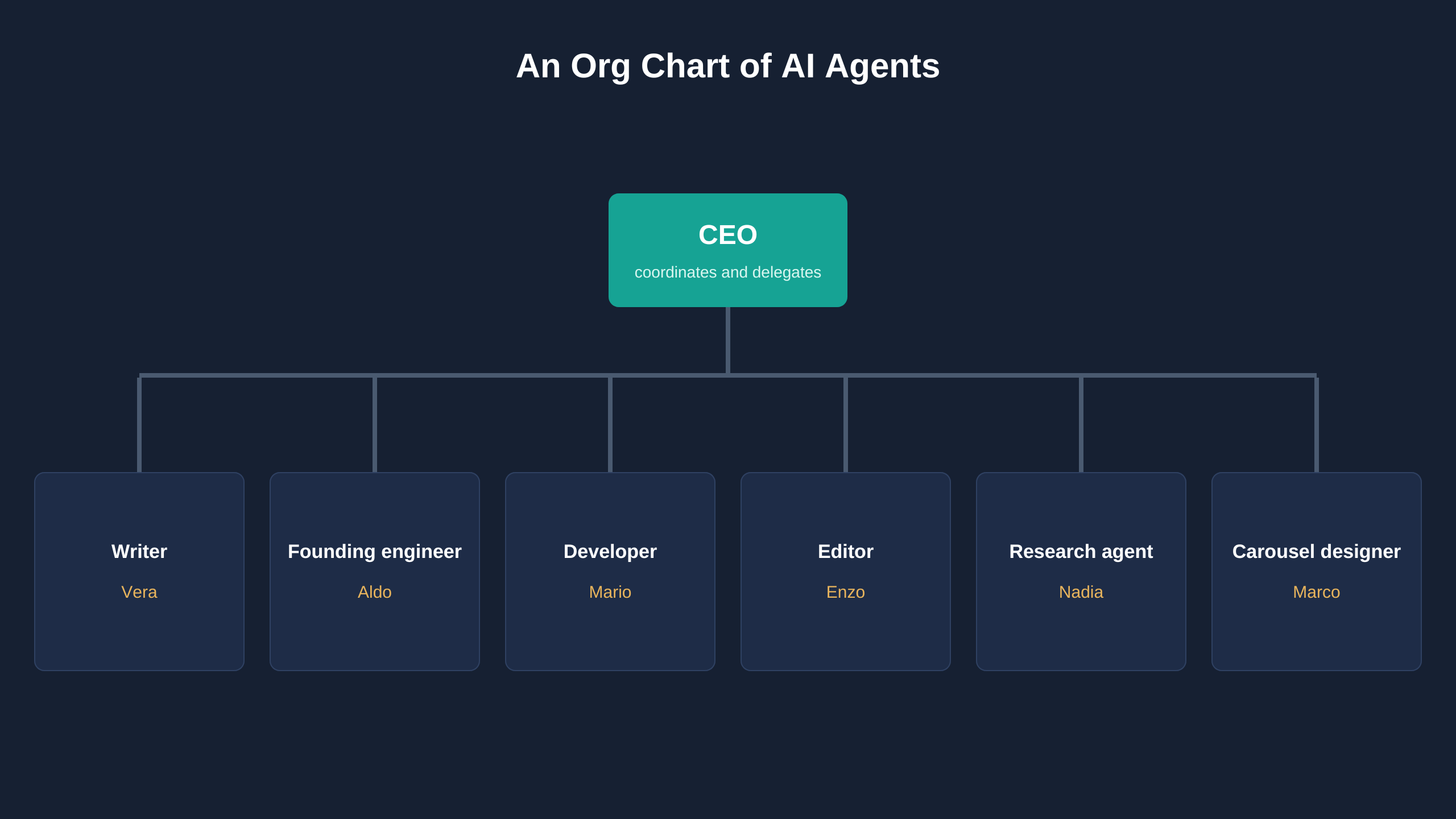
The heart of Paperclip is precisely the org chart representation. At the top there is a CEO who coordinates, and below a team of specialized figures that in my own case includes Vera as the writer, Aldo as the founding engineer, a developer dedicated to code, Enzo in the role of editor, Nadia as the research agent and Marco as the social carousel designer who produces the carousels for social media. Each agent is not a decorative label but an operating unit with a clear mandate, and the platform shows in real time how many agents are active at any given moment, which tasks they are running and where they stand. The most striking part is that, just as in a real organization, you can reconstruct what each agent has done and how much it has cost, following the entire record of activities, every decision taken and every tool call, and each one can be given a monthly budget beyond which it stops on its own. The project is structured into goals, tasks and subtasks that go into detail, so that complex work is broken down into verifiable steps instead of collapsing into a single opaque block.
Delegation, confirmation and the role of the entrepreneur
The aspect that makes Paperclip interesting for anyone running a business is the collaboration model it proposes. You can step directly into the group that is working, following for example an editorial review of the drafts and, right after, the production of the Instagram carousels drawn from the articles. At a certain point the agents reach their first results and stop, because they are waiting for a confirmation before moving on to the final stage. It is the same mechanism experienced by anyone who truly delegates: you assign a task, the team works autonomously, then comes back to you for an opinion or an approval on a delicate step, and you respond until the objective is reached. This checkpoint is not a slowdown to be removed but the guarantee that whoever knows the context and the clients remains the final voice on the decisions that matter. For anyone who wants to adopt a model like this, the most useful advice is precisely to design these checkpoints well, deciding in advance which steps can stay autonomous and which always require a human eye.
Multiple companies in parallel
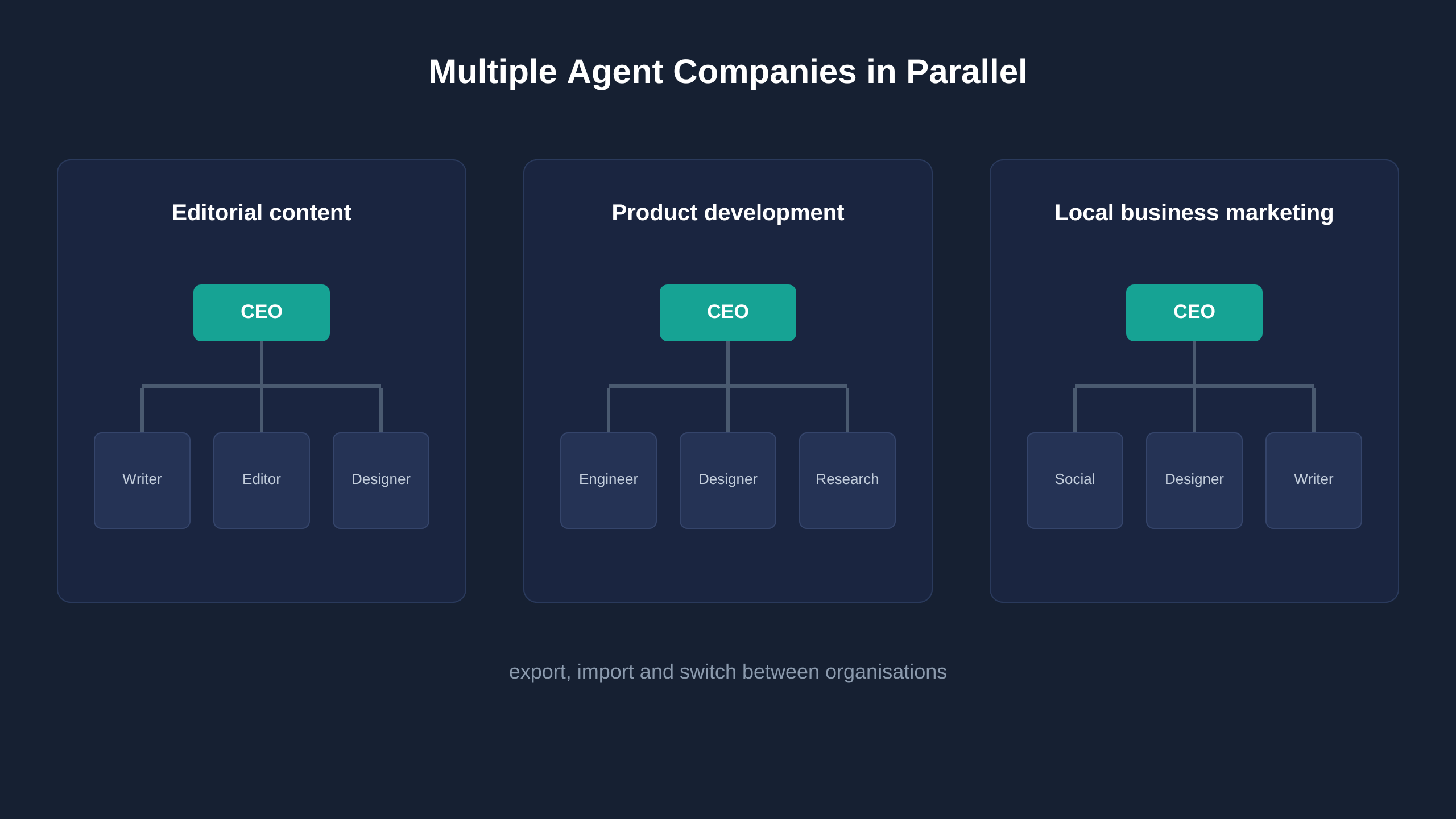
Paperclip does not stop at the single company. The platform lets you export and import an entire organization, and switch quickly from one to another with a simple toggle. This means that not only do you have several agents working in parallel within the same structure, but you can manage several distinct companies, each with its own team of agents dedicated to a specific context. One company for editorial content, one for product development, one for the marketing of a physical business, all separate but governable from the same interface. The ability to version and share these configurations also opens up an interesting scenario, that of treating the org chart itself as a reusable asset, a team template you can replicate, refine and adapt to different projects without rebuilding it from scratch every time.
Concrete use cases
The examples seen among the early adopters describe the flexibility of the tool better than any definition. A user with an ice cream shop built a team of agents for the entire marketing side, from carousels to images to the design of the new menus, going as far as identifying which flavors to buy and put on sale by following the trending tastes of the moment. Another, who rents out a padel court, assembled a team that handles marketing and communication with clients, writes the messages, asks for reviews and goes further, because during the matches he records the video and a group of agents dedicates itself to cutting the clips, adding live commentary, inserting effects and sending the result to the players. They are two very different physical businesses, yet both show the same principle, namely that a team of agents can support a physical business just as much as a digital one, from creating videos to developing applications and products.
Not the only one at this level
Paperclip is today among the most visible tools, but it is not alone in this direction. There are solutions such as Vibe Kanban that adopt the logic of Kanban boards, a sort of Trello where you watch the tasks move in real time from the to do state to in progress, then to in review and finally to done. The reason for this convergence is deep, because when you work and collaborate with a team of people you have always used tools like boards, timelines and calendars, and these are exactly the same metaphors that today allow you to coordinate a team of agents as if it were a real organization. The change is not so much in the underlying technology as in the way we think about it, because we stop treating AI as an oracle to question and start managing it as a resource to organize. Whoever learns to move from the prompt to delegation, defining clear roles and sensible checkpoints, will hold not a faster assistant but a team that works while you think about something else.
If you want to try it, you can find it here: https://paperclip.ing/